
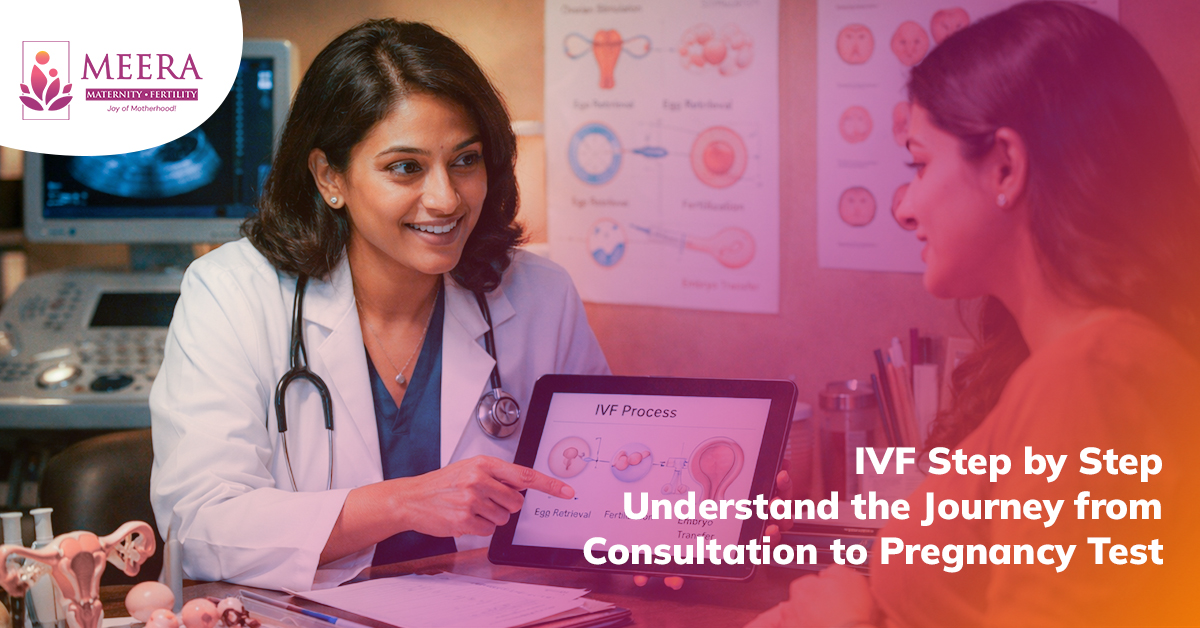
If you’ve been advised to consider IVF or are simply curious about what the process involves, it is completely normal to have questions. For many couples, the idea of IVF can feel confusing, emotional, and even a little overwhelming at first. You may have been trying to conceive for months or even years, and the next step can feel uncertain.
This guide is written for couples who are exploring IVF for the first time and want to understand how the treatment works before beginning the journey. In this article, we will walk through the IVF process step by step, from the first consultation with your doctor to the two-week wait after embryo transfer.
The goal is simple: to help you understand what happens at every stage, reduce fear around the treatment, and help you feel more prepared when speaking with your fertility specialist.
What Is IVF, and How Does It Work?
IVF stands for In Vitro Fertilisation. In simple terms, it means fertilising an egg with sperm outside the body in a laboratory. Once fertilisation happens, the resulting embryo is placed into the woman’s uterus so that pregnancy can begin.
IVF has been used around the world for several decades and has helped millions of couples have children. Today, it is a common fertility treatment in India and is recommended when couples face certain challenges with natural conception.
Doctors may suggest IVF for reasons such as blocked fallopian tubes, low sperm count, ovulation problems like PCOS, unexplained infertility, or when previous fertility treatments have not worked.
It is important to know that IVF is not a single procedure. It is a multi-step process that usually takes around 4 to 6 weeks per cycle, with each stage carefully monitored by the fertility team.
Step 1 – Initial Consultation and Tests
The IVF journey usually begins with a detailed consultation with your fertility specialist. This first visit is mainly about understanding your fertility history and identifying any possible reasons for difficulty in conceiving.
Your doctor will ask questions about how long you have been trying to conceive, previous pregnancies, menstrual cycle patterns, and any treatments you may have already tried. This helps the medical team build a clear picture of your situation.
Both partners will usually undergo a few tests. For women, doctors may check hormone levels such as AMH, FSH, and LH, perform an ultrasound to assess ovarian reserve, and examine the uterus. For men, a semen analysis is done to evaluate sperm count, movement, and shape.
Based on these results, the doctor designs a personalised IVF treatment plan, because no two couples have exactly the same fertility needs. This stage may also include advice about nutrition, lifestyle, and emotional support during treatment.
Step 1 – Initial Consultation and Tests
The IVF journey usually begins with a detailed consultation with your fertility specialist. This first visit is mainly about understanding your fertility history and identifying any possible reasons for difficulty in conceiving.
Your doctor will ask questions about how long you have been trying to conceive, previous pregnancies, menstrual cycle patterns, and any treatments you may have already tried. This helps the medical team build a clear picture of your situation.
Both partners will usually undergo a few tests. For women, doctors may check hormone levels such as AMH, FSH, and LH, perform an ultrasound to assess ovarian reserve, and examine the uterus. For men, a semen analysis is done to evaluate sperm count, movement, and shape.
Based on these results, the doctor designs a personalised IVF treatment plan, because no two couples have exactly the same fertility needs. This stage may also include advice about nutrition, lifestyle, and emotional support during treatment.
Step 3 – Egg Retrieval
Once the follicles have grown to the right size, the next step is egg retrieval. This is a short medical procedure where the doctor collects the mature eggs from the ovaries.
The procedure is usually done under mild sedation or anaesthesia, so the patient stays comfortable and does not feel pain during the process. Using ultrasound guidance, the doctor inserts a thin needle through the vaginal wall to reach the ovaries and gently collect the eggs from the follicles.
The entire procedure usually takes about 15 to 30 minutes. The number of eggs collected can vary from person to person, but in many cycles, doctors may retrieve around 8 to 15 eggs if the response to stimulation is good.
After the procedure, most patients rest at the clinic for a few hours and can go home the same day. The collected eggs are immediately taken to the embryology lab, where the next stage of the IVF process begins.
Step 4 – Fertilisation in the Lab
After the eggs are retrieved, they are carefully examined in the embryology lab to check their maturity. Only mature eggs are suitable for fertilisation.
Next, the eggs are combined with sperm from the partner or a donor. There are two main ways this can happen. In conventional IVF, the eggs and sperm are placed together in a special dish so fertilisation can occur naturally. In ICSI (Intracytoplasmic Sperm Injection), a single healthy sperm is injected directly into each egg. Doctors usually recommend ICSI when sperm count or quality is low.
After about 16 to 18 hours, the embryologists check whether fertilisation has occurred. The fertilised eggs, now called embryos, are then carefully grown in the lab for three to five days.
During this time, the embryos are monitored and graded based on their development. The best-quality embryo or embryos are then selected for the next step of the IVF process.
Step 5 – Embryo Transfer
Embryo transfer is one of the most important moments in the IVF process. This is the stage where the selected embryo is placed into the woman’s uterus in the hope that it will implant and lead to pregnancy.
The procedure itself is simple and usually painless. The doctor uses a thin, flexible catheter to gently place one or sometimes two embryos into the uterus. In most cases, anaesthesia is not needed, and the process typically takes 10 to 15 minutes.
There are two types of embryo transfers. In a fresh embryo transfer, the embryo is placed in the uterus a few days after fertilisation. In a frozen embryo transfer, embryos that were previously frozen are thawed and transferred during a later cycle.
After the procedure, doctors usually prescribe progesterone supplements to support the uterine lining. Any remaining good-quality embryos can also be frozen and stored for future IVF cycles if needed.
Step 6 – The Two-Week Wait
After the embryo transfer, the next stage is often called the two-week wait. This is the time between the embryo transfer and the pregnancy test. For many couples, this can be the most emotionally challenging part of the IVF journey.
During these 14 days, the embryo is trying to implant into the lining of the uterus. If implantation happens successfully, pregnancy begins. However, this process takes time, which is why doctors recommend waiting before testing.
Some women may notice symptoms like mild cramps, bloating, or breast tenderness. But it is important to know that these symptoms can also be caused by progesterone medications, so they are not a reliable sign of pregnancy.
Doctors usually advise avoiding heavy exercise, reducing stress, and focusing on rest and gentle daily activities during this time. At the end of the two weeks, a blood test called beta-hCG is done to confirm whether the treatment has resulted in pregnancy.
IVF Success Rates: What to Realistically Expect
When couples start IVF, one of the first questions they often ask is about success rates. While IVF has helped many families conceive, it is important to understand that results can vary from person to person.
In general, IVF success rates in India are around 40 to 50 percent per cycle for women under 35. As age increases, the chances of success gradually decrease because egg quality and quantity naturally decline over time.
Several factors can influence IVF outcomes. These include the woman’s age, ovarian reserve, embryo quality, uterine health, and lifestyle factors such as nutrition, stress levels, and overall health.
It is also important to remember that many couples need more than one IVF cycle, and this is completely normal. In fact, the chances of success often improve across multiple cycles rather than a single attempt.
IVF at Meera Maternity Centre, Kumbakonam
At Meera Maternity Centre, we understand that IVF is not just a medical treatment. For many couples, it is an emotional journey filled with hope, questions, and sometimes uncertainty. That is why the focus is not only on medical care but also on providing support at every step.
Dr. Shereen and the fertility team offer personalised IVF treatment plans based on each couple’s specific fertility needs. The centre provides a range of fertility services, including ovulation induction, IVF, ICSI, and related treatments.
Couples also receive guidance on lifestyle, emotional wellbeing, and stress management during treatment. Psychological support and counselling are available to help patients feel supported throughout the process.
Located in Kumbakonam, Meera Maternity Centre has helped more than 2,000 families on their fertility journey, combining clinical expertise with compassionate care.
Common Questions About IVF Treatment
Is IVF painful?
Most people are surprised to learn that IVF is not as painful as they expect. The egg retrieval procedure is done under sedation, so you will not feel discomfort during the process. The hormone injections during the stimulation phase may cause mild bloating or tenderness, but most patients manage them comfortably with guidance from their medical team.
How many IVF cycles will I need?
This can vary for each couple. Some couples achieve pregnancy in their first cycle, while others may need two or three cycles. After each cycle, your doctor reviews the results and may adjust the treatment plan to improve the chances of success.
What is the right age to start IVF?
IVF success rates are generally higher in women under 35. However, women in their late 30s and early 40s can still have successful outcomes. The most important step is to consult a fertility specialist early to understand your options.
Does IVF guarantee a pregnancy?
No fertility treatment can guarantee pregnancy. IVF improves the chances for couples who are struggling to conceive naturally, but the outcome depends on several factors, such as age, egg quality, sperm health, and overall fertility conditions.
Book a Fertility Consultation
If you are considering IVF or want to understand your fertility options better, speaking with a specialist is the best first step. At Meera Maternity Centre in Kumbakonam, Dr. Shereen and the fertility team are here to guide you through every stage of the IVF journey with care and clarity.
From the first consultation to treatment planning and emotional support, the team focuses on helping you feel informed, supported, and confident throughout the process.